
Frequently Asked Questions
Everything else you might need to know about Bear Decisions
Why spreadsheets alone won't work
Unbearable swarming pain, that every Excel user knows.

Lack of communication
- ✕Stakeholders want the "why," not just the "what."
- ✕Unstructured analysis, testing multiple hypotheses, makes it hard to package a clear narrative behind your numbers.
Hidden pitfalls & missed opportunities
- ✕What-if analysis that never captures the full range of possibilities. Discovery of key risks is slow and often too late.
- ✕Without grouping or probabilistic weighting, you focus on the wrong scenarios, and every plan assumes you'll decide on everything right now, with today's information.
Manual entry & version chaos
- ✕Hours lost copying values into new workbooks or tabs again (and again). Then validating the data integrity.
- ✕Multiple "final-plan_v4 (updated) 2.xlsx" files. None of which you truly trust.
Why Excel users love Bear Decisions
Built for those of us who love (?!) our spreadsheets.

Save time & eliminate errors
Automate scenario generation and maintain a single source of truth
Automated scenario generation
- •Generate 100+ variations in seconds. No more manual "save as" or cut-and-paste.
- •Avoid version control nightmares. Make a change once; test it across all scenarios instantly.
Single source of truth
- •Run every case from one model. No more juggling "final" spreadsheets across different options.
- •Your one master workbook stays intact, so updates and corrections happen once, everywhere.
One-click back-population
- •Select a preferred scenario and push it directly into your Excel model. No manual re-entry of values needed.
- •Iterate and refine in real-time, maintaining existing formulas and macros.
Gain deeper insight
Understand probabilities, visualize outcomes, and compare strategies across every scenario
Probabilities by design
- •Assign probabilities to each area of uncertainty; Bear Decisions auto-calculates the combined likelihood of each scenario.
- •Weight every outcome by its likelihood, and still see the tails.
- •Iterate on probabilities without regenerating the scenarios. Rapidly test the bounds of imprecise and potentially disputed probabilities.
Smart grouping & analysis
- •Instantly group outcomes by Decision, Uncertainty, Strategy or Instance to pinpoint critical risk drivers.
- •Evaluate all cases, not just the ones that looked promising upfront, to surface hidden opportunities and avoid costly blind spots.
- •See Expected Value, Min/Max, Mean, Median, or a Decision vs Uncertainty grid with a click.
Strategies & decision paths
- •Judge today's decision on what you'd do next, not on a plan fixed up front.
- •Define your response to each outcome at each stage, and Bear Decisions builds out every resulting path.
- •Account for what you'll learn between decisions, even partial or imperfect signals.
- •How sequencing works →
Communicate & collaborate
Present the full picture, and the reasoning, behind every decision
Presentation-ready dashboard
- •Export charts and data behind them instantly, and embed easily into slide decks or reports.
- •Share interactive insights rather than cobbling screenshots together.
Build the case stakeholders can trust
- •Quantify the upside potential and downside risk per strategy. Stakeholders need to understand not just which path is best, but what's at stake across every condition.
- •Build narratives around risk: show why a given choice makes sense, backed by hard numbers and clear visuals.
- •Compare outcomes against a previous forecast, budget, or KPI, and know the probability of beating it, per strategy.
So, what does this really look like?
One Model. Hundreds of Possibilities
Imagine that...
- You are managing a facility and have two areas of decisions you need to consider:
- • Whether you should expand the plant (yes or no)
- • How much total budget you are going to ask for (maintaining existing, higher or lower)
- When you are considering these decisions, you have also identified three areas of uncertainty:
- • The price of the product you are selling (high, base or low)
- • The interest rate you will be charged on the loan you are taking out (high, base or low)
- • Other miscellaneous risks that may impact your decision (high, base or low)
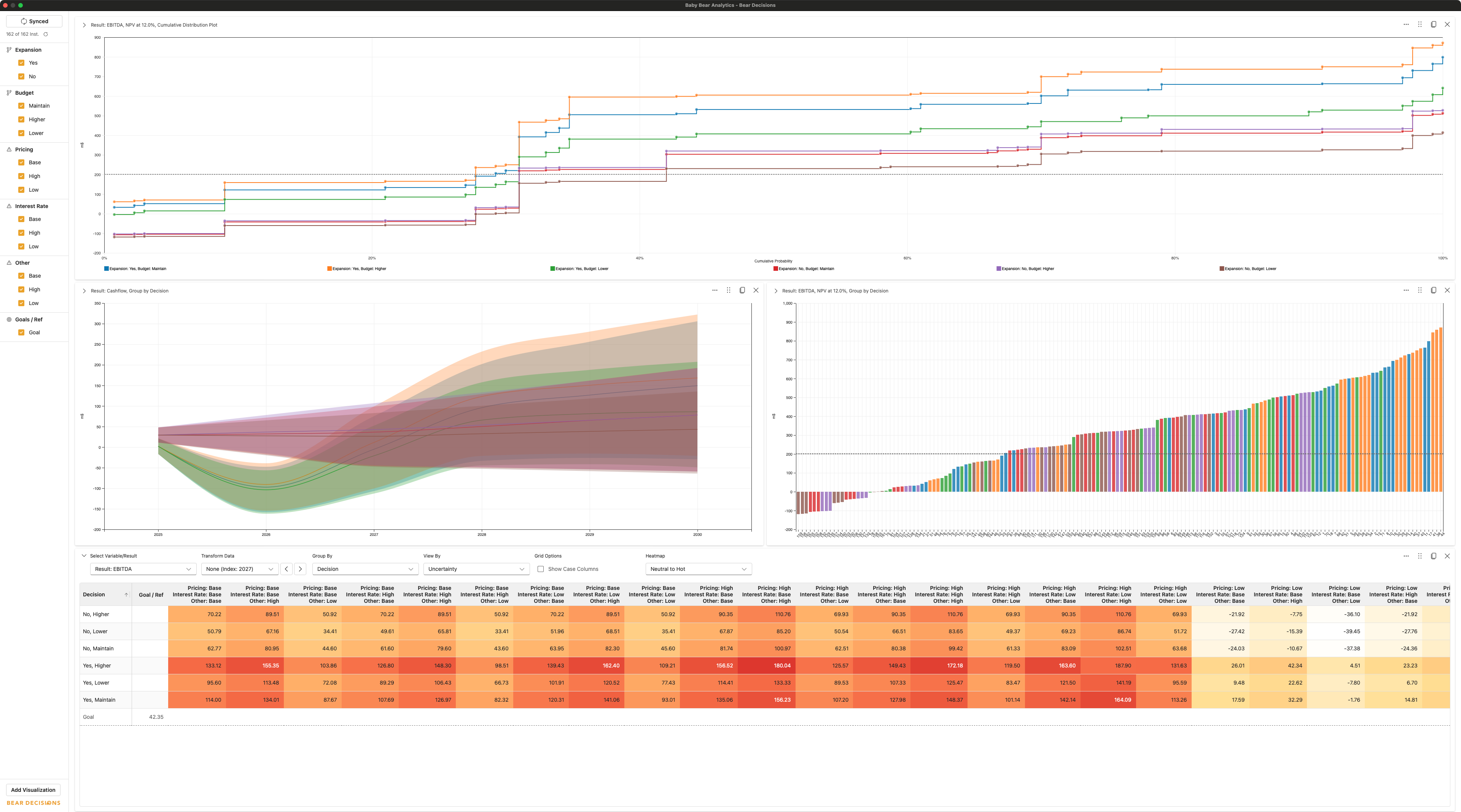
- If you were to use Bear Decisions, you would be able to:
- • See that there are 6 different decisions you could make
- • See that there are 27 different outcomes you could see per decision
- • Consider the full 162 different scenarios you could see based upon the combination of the decisions and uncertainties
- • Identify which decision holds up across the range of outcomes
Would you say yes to manually building 162 different scenarios?
Other Questions?
Does this replace Excel?
Not at all. It runs entirely within Excel – your model (and data) stays yours.
Does my workbook data leave Excel?
No. The analysis runs locally and nothing from your spreadsheet is sent to our servers.
You can share the file with colleagues like any other workbook, with no need to strip out special formulas first. You can also export a full set of results, formatted for easy import into PowerBI or your own pivot table.
For IT: what we collect → IT guide.
So how does it change my Excel model?
The only required changes will be to have your alternative inputs stored somewhere within your Excel model. Bear Decisions will then use these inputs to generate the scenarios and visualizations. They can be on a separate sheet or in the same sheet as your existing key inputs.
Over time, you may choose to focus the analytics and graphs within your Excel model to dive deeper into individual scenarios and allow Bear Decisions to handle the heavy lifting of calculations and comparisons between cases.
Can I use my macros and formulas?
Yes! We work with your model, not around it.
If you do have macros and you flag that you want to use them, by default we just pause the calculation process for you to manually trigger your macro(s) due to limitations on Microsoft's APIs.
Documentation is provided however to automate the triggered macro execution process. (It does require pasting in some standard VBA code however, sorry!)
Does it work with linked Excel files?
Yes! Just like with Macros, we work with your model, not around it.
If you do have formulae that link your main calculation model to another Excel file, this will automatically recalculate/update as necessary so long as it is open. This may cause some small reductions in speed because the scope of every calculation is now bigger (two or more spreadsheets instead of just the one!), but this is typically not material.
Do I need to know any coding?
No! Bear Decisions does not require any coding expertise.
All calculations use your Excel document's logic, we just aggregate and filter the results based upon your selections.
The only exception is if you already have VBA to trigger macros: if you want to automate their triggering then you will need to paste in some standard VBA code.
Do I have to evaluate every decision at the same time?
No. Mark the decisions you can make later, and what you expect to learn over time. Bear Decisions works backwards from the last decision to value each path, so the expected value of today's decision is judged on what you'd do next. Automatically get the best decision or manually adjust what you would do in different circumstances.
More on the Sequencing page →
Where do the probabilities come from?
From you. Use the P10, P50 and P90 forecasts you already have, your team's judgment, or start with equal likelihoods and refine. Changing a probability doesn't regenerate the scenarios, so you can test how much a disputed estimate matters before the argument starts.
Can't I just ask ChatGPT or Claude to do this for me?
You can. Ask an AI to run your model 100 times and it will, and you'll have thousands of results to work with. The hard part comes next: pulling the right result for each option and joining it to the right probabilities. In our experience, that's where AI gets it wrong, and a wrong join looks just like a right one on the chart. The reliable way to use AI here is to have it write code that does the pulling and joining the same way every time. That code is what Bear Decisions is: built, tested and maintained, so your team (or your boss) gets the same answer on every run.
How is this different to Excel's built-in What-If Analysis?
Excel's built-in What-If Analysis is a great tool, and it's a great place to start. However, it has some limitations.
First, its data table only allows you to compare two inputs at a time. Bear Decisions allows you to test multiple inputs at once, and see the impact on the results.
Second, it only allows you to see the results of a single scenario in full. Bear Decisions allows you to see the results of multiple scenarios, compare them to each other and then bring the full details of a specific scenario back to your Excel model.
Third, it doesn't allow you to include likelihoods on the uncertainties being tested, so you are left with just data, not insight. Bear Decisions allows you to include likelihood on all the uncertainties being tested, including conditional dependencies, so you can see the risk of the options, build an expected value and see a full cumulative distribution of the outcomes.
How is this different from @RISK or Crystal Ball?
Those tools sample your uncertain inputs at random and report the range for the output cells you point them at. Bear Decisions runs every decision option against every combination of the uncertainties, and tracks every result you tell it you care about (production, cashflow, reserves) at the same time. You get the multi-result view from one run, and you can change what you're looking at without running it again.
Rather than a focus on individual cells, Bear Decisions considers time series as the primary input and output, and new alternative inputs can be easily generated based upon them. Results are carried through to the rest of the business in a form stakeholders can read in Excel, without proprietary software of their own. The decision structure is built in: decision trees, staged decisions and backward induction, all in one package.
Is this Monte Carlo?
Not yet. Bear Decisions runs every option against every combination of your uncertainties, each with a likelihood. There's no sampling noise, and you can trace any result back to the scenario behind it.
How long does it take to see a benefit?
Bear Decisions deploys in under a minute. Your first analysis on the example model takes about 20 minutes. The tool is flexible enough that your own model can be rapidly configured as-is, helping you to start gaining insight immediately, not weeks or months down the track.
How many cases can it run, and how long does a run take?
Bear Decisions scales into the thousands of iterations considered.
Run times will depend on your model and your computer. The example model runs in under 10 seconds. Typically a complex model might take 20 minutes to an hour pending how many iterations and how fast an individual calculation is.
How much does Bear Decisions cost?
Bear Decisions starts at USD 200 per month, with an annual option. You can try it free for 14 days, no credit card required. It works alongside the tools you already use.
What happens after the 14-day trial?
Your access ends. You go back to using your Excel file like it was before.
We don't take a card at sign-up, so there's nothing to cancel.
(Though we would love any feedback you have on why it wasn't suitable for you at this time!)
How will Bear Decisions help me avoid version chaos?
Well unfortunately we cannot promise you aren't still going to have a document called "final-plan_v4 (updated) 2.xlsx" but what we do offer is the ability to see all your what-if questions answered within a single document, so no more copying files to represent different cases.
Having that single version also means that if you do find an error, want to add a calculation nuance or need to add a new input or reporting detail, you can make that change just once, test across the entire spectrum of cases and validate that it has worked with no surprises. This helps you rapidly iterate to get that change right and know that your cases all remain consistently evaluated – helping you make confident data-driven decisions, free from bias.
What if I want to dig deeper into a visualization?
Each visualization has the ability to copy the data behind it to the clipboard, enabling you to paste it wherever you need to dig into the details.
You can also click into a visualization, then send a specific scenario back to the Excel model to see the full details of that scenario.
What versions of Excel are supported?
Windows and Mac desktop Excel, Excel on the web, and the iPad app. Excel 2021 or Microsoft 365 works. Single sign-on needs Office from May 2025. On earlier versions you sign in with an email code instead. We recommend desktop Excel for the most control and the fastest calculation.
For IT: approval guide →
Can you do the analysis with us?
Yes. Some teams just want the answer, not software. We will run the analysis with you, on your decision, as part of a consulting engagement.
And who would you be?
I'm Mark, the founder of Baby Bear Analytics. I have spent over a decade working in the energy industry, with a focus on planning and budgeting, and a passion for helping teams make better decisions. See more in my about section.